
SRI VIJAYA PURAM | NOVEMBER 7, 2026 | DWEEP TULIKA | ANDAMAN NEWS
By Dweep Tulika News Desk
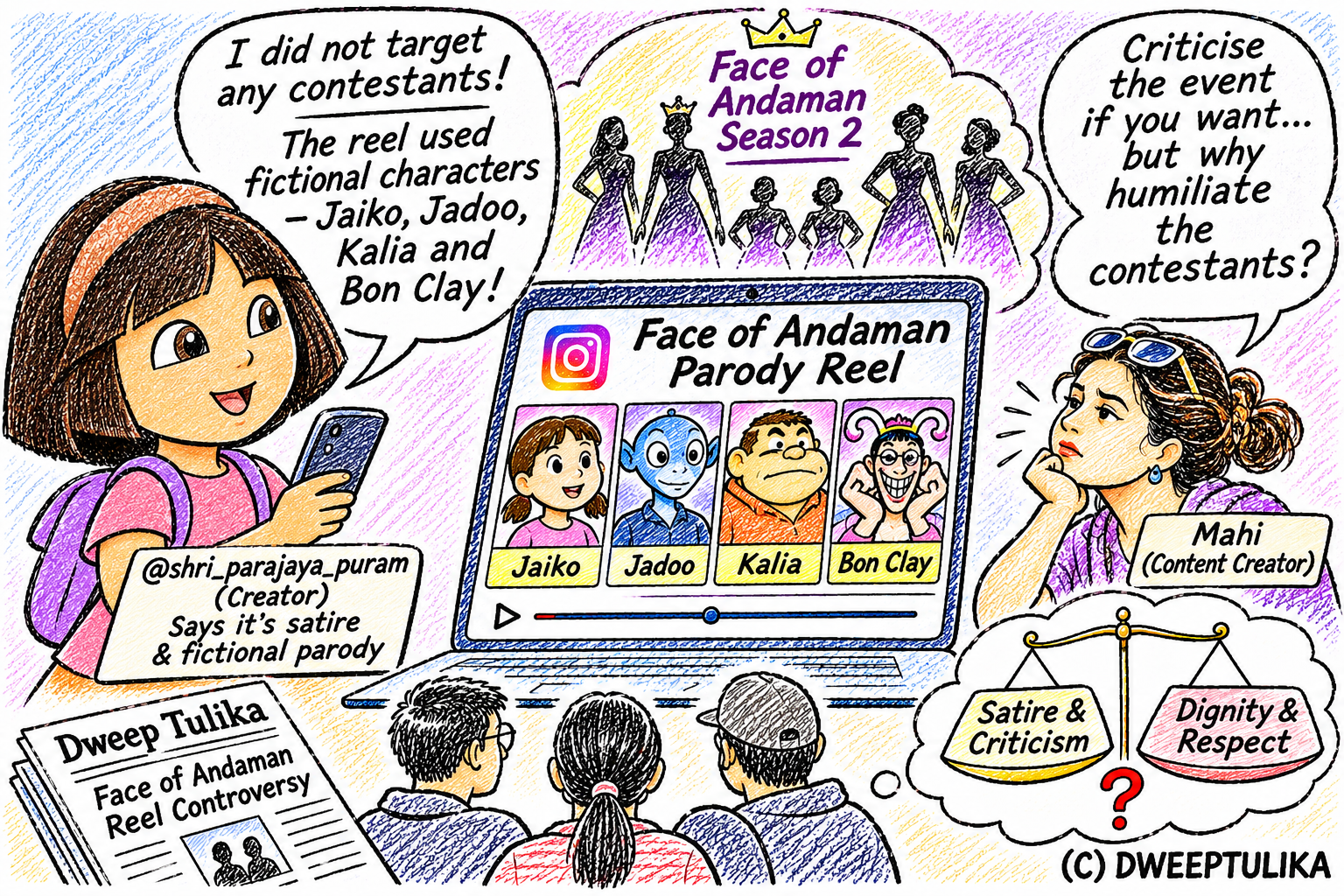
An Instagram account associated with a controversial AI-generated parody reel targeting Face of Andaman has disputed allegations that the content used manipulated photographs of actual contestants, maintaining that the visuals featured fictional cartoon, anime and film characters.
The response follows Dweep Tulika's earlier report on concerns surrounding a reel published by the account operating under the username @shri_parajaya_puram. The creator has stated in a written response to the publication that the content was not intended to identify, target or personally attack any Face of Andaman contestant.
The controversy centres on a reel carrying the caption "CHEHRA OF ANDAMAN SEASON 1", accompanied by a mock voting and competition format. It combines AI-generated visuals with a song containing sexually vulgar and derogatory expressions referencing Face of Andaman.
Creator Says Four Fictional Characters Were Used
In the written response, the creator questioned the suggestion that actual contestants had been depicted through manipulated images and asked which individuals' photographs or identities were being referred to.
The creator identified the four characters used in the reel as:
Jaiko: Gian's sister from Doraemon.
Jadoo: The extraterrestrial character from the film Koi... Mil Gaya.
Kalia: A character from Chhota Bheem.
Bon Clay: A character from the anime One Piece.
According to the creator, these are fictional characters and not photographs of Face of Andaman participants.
The creator also questioned whether any contestant's name, photograph or identity had explicitly been used in the reel and argued that criticism of the event should not automatically be characterised as personal targeting.
What the Reel Shows
Screenshots of the reel examined by Dweep Tulika show four mock candidates presented in a competition-style format, with candidate numbers, names, categories and voting prompts.
The displayed names include "Hizar Kaalu", "Sookhi hui Jagdu", "Neeko Hizar" and "Mrs. Chakkesh".
The visuals place the figures against backgrounds associated with the islands, including depictions of Cellular Jail and the Port Blair waterfront. Some category descriptions incorporate rainbow symbols, while another uses the description "EXTRATERRESTRIAL".
The creator's explanation identifies the fictional characters that inspired the visuals. The screenshots examined by Dweep Tulika do not establish that actual contestants' photographs were manipulated.
This clarification is important in assessing the visual component of the controversy. However, the use of fictional characters does not, by itself, settle questions about the overall presentation or the language accompanying the reel.
Questions About the Song's Language Remain
While the creator disputed the allegation concerning the use of contestants' photographs, the written response did not directly address the specific lyrics of the accompanying AI-generated song.
The audio repeatedly references Face of Andaman and contains sexually explicit and derogatory expressions.
One portion uses the phrase "ladkiyon ke vesh mein hai darinda", while another contains vulgar language directed at people responding to comments.
The lyrics also make references to perceived identity, recognition and public standing.
The distinction between fictional characters in the visuals and the language used in the audio is significant. Establishing that fictional characters were used does not automatically resolve concerns about the song's wording or its possible interpretation by viewers.
Creator Questions Dweep Tulika's Earlier Reporting
The creator also challenged the journalistic process followed in the earlier coverage, arguing that a publication should examine the original material and verify claims before presenting interpretations as established facts.
The response emphasised the distinction between criticism, satire and personal harassment, and requested that Dweep Tulika reconsider its presentation after examining the characters used in the reel.
Dweep Tulika acknowledges this response and clarifies that the screenshots subsequently examined do not establish the use of actual contestants' photographs. The creator's explanation of the four fictional characters has been incorporated into this follow-up report.
Mahi's Earlier Objection to Online Humiliation
Separately, Andaman-based digital creator Jasmin Nisha, popularly known as Mahi, had expressed concern about the trolling of individuals associated with Face of Andaman.
In her video, Mahi said that she was not necessarily a supporter of the competition or other local shows, but questioned why contestants should face humiliation over their appearance, body shape or identity.
She argued that criticism should be directed towards organisers when concerns relate to an event's functioning, credibility or standards.
Mahi also spoke about her own experience of online trolling and the lasting impact it had on her life.
Her position was that disagreement with an event should not become a reason to humiliate its participants.
Where Does Satire End and Personal Humiliation Begin?
The exchange highlights a wider question about the boundaries of satire and responsible content creation.
Public events, competitions and their organisers can be criticised. Questions concerning selection procedures, judging standards, transparency and credibility are legitimate subjects of public discussion. Satire and parody are also recognised forms of expression.
At the same time, the language and context of a parody matter. Sexually degrading expressions, personal ridicule and references to gender identity can raise concerns about how individuals and communities are represented.
The inclusion of rainbow symbols in some categories does not, on its own, establish discriminatory intent. Their meaning must be considered alongside the wider presentation and accompanying lyrics.
The debate is therefore not limited to whether fictional characters or actual photographs were used. It also concerns the overall message conveyed by the content and how audiences interpret it.
AI Content and Digital Responsibility
Artificial intelligence has made the creation of songs, images and videos considerably more accessible. This has expanded opportunities for creative expression, parody and humour, but also increased the importance of responsible content creation.
In a relatively small community such as the Andaman and Nicobar Islands, online material can quickly become the subject of public discussion. Its circulation may affect people beyond the creator's intended audience.
The present controversy brings together two important considerations: the freedom to criticise and parody public events, and the responsibility to consider the language and representations used in doing so.
A Clarification from Dweep Tulika: The creator's written response has been incorporated into this report. The screenshots examined do not establish that actual Face of Andaman contestants' photographs were used in the reel. The creator's explanation that the visuals feature fictional characters is presented as their stated position. The account operator's identity has not been independently verified.
The questions concerning the song's language, the intended nature of the parody and its interpretation remain open to discussion.
This report is based on the creator's written response, screenshots of the reel supplied for examination and Mahi's previously published video statement. No conclusion is drawn regarding the commission of any legal offence.