
HYDERABAD, October 14, 2026:
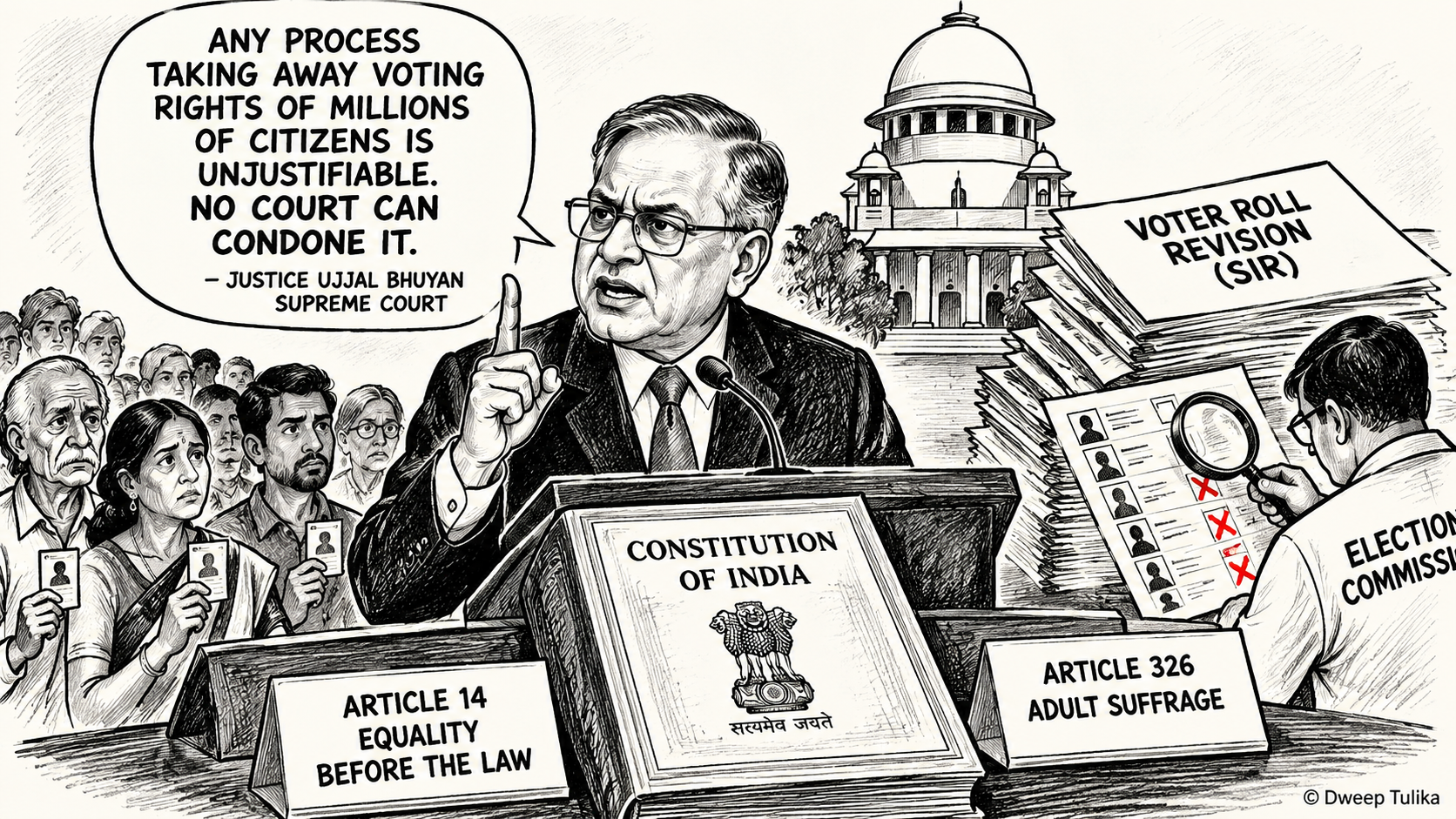
Supreme Court Justice Ujjal Bhuyan has said that any process resulting in the disenfranchisement of millions of Indian citizens would be intrinsically arbitrary and contrary to the constitutional order, as controversy continues over the Election Commission’s Special Intensive Revision (SIR) of electoral rolls.
Justice Bhuyan made the remarks while delivering the valedictory address at the 19th NALSAR–Justice B.R. Sawhny Memorial Moot Court Competition in Hyderabad on October 4, according to reports by legal news outlets.
“If any process results in disenfranchising millions and millions of Indian citizens … such a process is intrinsically arbitrary,” Justice Bhuyan said, according to LiveLaw. He added that no amount of “whataboutery” could justify such a process and that it would strike at the heart of the Constitution.
Justice Bhuyan stressed that the Constitution does not envisage two classes of citizens—those with voting rights and those without them. He linked the right to vote and inclusion in electoral rolls to the constitutional framework, particularly Articles 14 and 326.
Article 14 guarantees equality before the law and equal protection of the laws. Article 326 provides for elections to the Lok Sabha and state legislative assemblies on the basis of adult suffrage, subject to constitutional and statutory qualifications.
SIR and concerns over voter exclusion
The remarks have drawn attention amid the continuing national debate over the Election Commission’s Special Intensive Revision of electoral rolls. The exercise is intended to verify and update voter lists, including the removal of entries that are ineligible under applicable rules.
Opposition parties and civil society groups have raised concerns that eligible voters could be wrongly excluded during the process, particularly where documentation requirements, verification procedures or difficulties in accessing remedies create obstacles.
Critics have called for transparent procedures, accessible verification and effective opportunities for affected voters to challenge proposed deletions.
The Election Commission is responsible for maintaining accurate electoral rolls. The central issue in the debate is how that responsibility can be exercised without arbitrarily excluding citizens who are legally eligible to vote.
Justice Bhuyan’s speech did not explicitly name the SIR exercise, according to NE NOW. His remarks were made against the backdrop of the wider controversy over electoral-roll revision.
Constitutional safeguards and due process
Justice Bhuyan’s observations underline the constitutional significance of ensuring that eligible citizens are not deprived of voting rights through arbitrary or procedurally unfair action.
Questions of notice, verification, access to documents and opportunities to challenge errors are central to the debate over electoral-roll revision.
For voters whose names are missing from electoral rolls, clear information and effective remedies are particularly important. Errors in records, changes of residence and difficulties in establishing eligibility must be addressed through lawful procedures that provide affected individuals a meaningful opportunity to respond.
Remarks are not a judicial ruling on the entire SIR exercise
Justice Bhuyan made the observations in a public address at an academic event. They should not be interpreted as a judicial order declaring the entire Special Intensive Revision exercise unconstitutional.
The Election Commission’s authority to revise electoral rolls, the procedures it follows and the safeguards available to affected voters are distinct legal questions. The legality of a particular measure depends on the applicable law, the facts and any relevant judicial orders.
The remarks nevertheless place the protection of voting rights and the constitutional consequences of mass exclusion at the centre of the public debate over electoral-roll revision.
The broader challenge remains how electoral authorities can maintain accurate voter lists while ensuring that eligible citizens have a fair opportunity to exercise their democratic rights.
Sources: LiveLaw, October 4, 2026; NE NOW, October 4, 2026; NDTV, October 4, 2026. The connection between the speech and the SIR debate is contextual; Justice Bhuyan did not explicitly name the exercise in his speech, according to NE NOW.