
OSLO | OCTOBER 9, 2026 | DWEEP TULIKA | WORLD
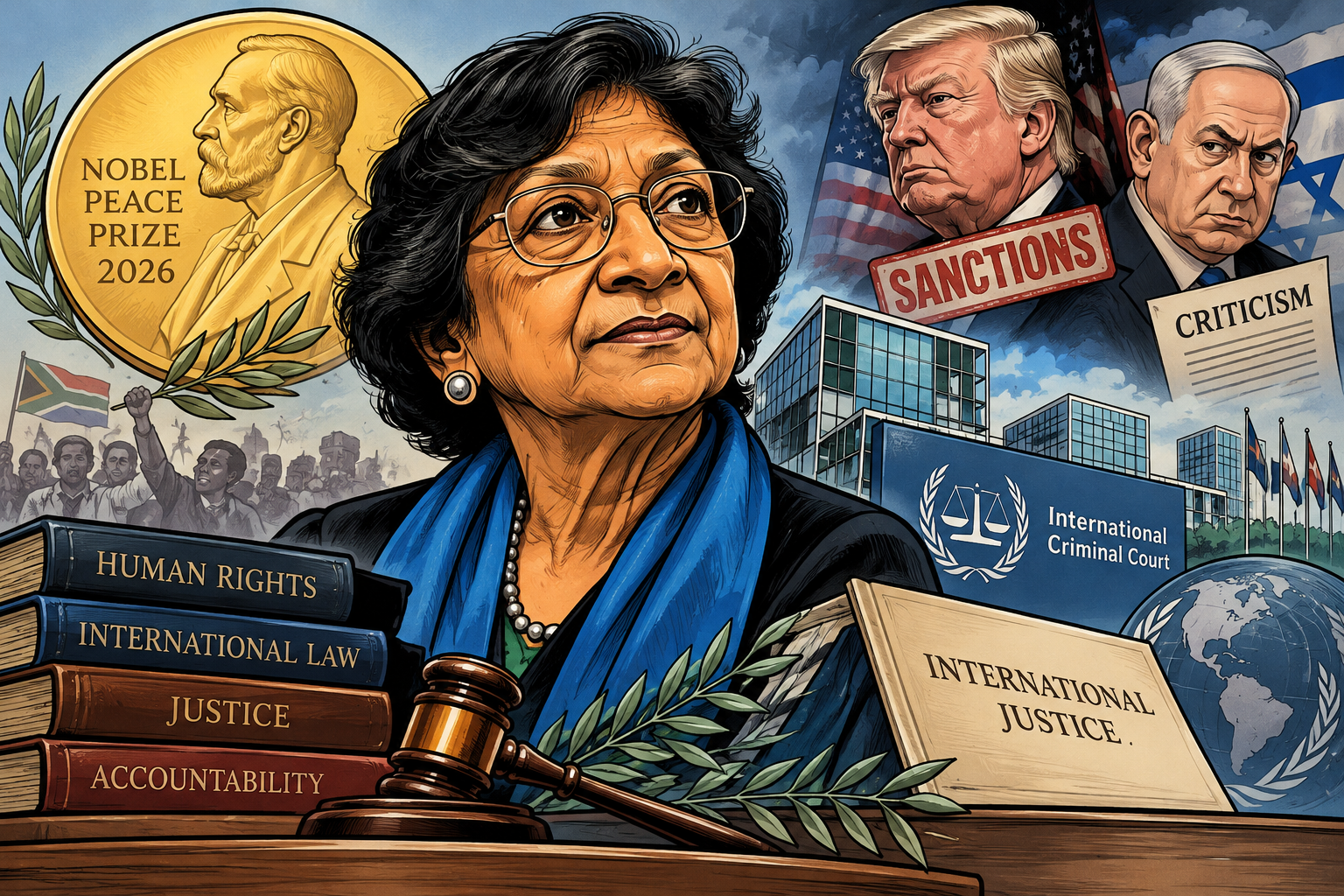
The Norwegian Nobel Committee announced the award on October 9, recognising Pillay's decades-long contribution to international justice and her role in advancing legal accountability for war crimes, crimes against humanity and genocide. The committee said her career demonstrated the importance of upholding the rule of law at a time when international legal institutions face growing political pressure.
The award comes amid intensifying disputes over the authority of international courts, including the International Criminal Court (ICC), and the ability of international institutions to hold powerful states and political leaders accountable.
From apartheid-era South Africa to international justice
Born in Durban, South Africa, in 1941 to a family of Indian Tamil origin, Pillay grew up under apartheid, a system of racial segregation and discrimination that denied basic rights to the country's Black majority and other non-white communities.
In 1967, she became the first woman to establish a law practice in what was then Natal Province. She defended anti-apartheid activists and advocated for political prisoners, including Nelson Mandela and others who challenged the apartheid system.
In 1995, following the end of apartheid, Pillay became the first Black woman appointed to South Africa's High Court. Her subsequent career took her into international criminal justice, where she helped shape legal standards for the prosecution of mass atrocities.
She served as a judge and later president of the International Criminal Tribunal for Rwanda, which was established to prosecute those responsible for the 1994 genocide and other serious violations of international humanitarian law.
One of the tribunal's landmark developments came in the 1998 Akayesu judgment, which recognised that rape and sexual violence could constitute acts of genocide when committed with the requisite intent to destroy a protected group. The judgment also established important precedents concerning sexual violence as a crime against humanity.
Pillay subsequently served as a judge at the International Criminal Court from 2003 to 2008. She was appointed United Nations High Commissioner for Human Rights in 2008, serving until 2014 and advocating for equality, protection against discrimination and accountability for serious human rights violations.
Why the Nobel Committee chose her
The Nobel Committee's citation emphasised Pillay's contribution to strengthening international legal institutions and establishing that individuals responsible for grave international crimes should be held accountable.
Its announcement also stressed that the international legal order is under considerable pressure and that judges and institutions responsible for upholding it face political attacks.
The committee presented the award as a reminder that lasting peace depends on legal frameworks capable of resolving disputes without force and ensuring that victims of violence can seek justice.
The 2026 prize is therefore not simply recognition of an individual career. It also draws attention to a broader question: whether international law can remain effective when powerful governments challenge the jurisdiction, independence or findings of the institutions applying it.
Gaza inquiry places Pillay at the centre of controversy
Pillay's work has also attracted significant political criticism, particularly over the Israeli-Palestinian conflict.
From 2021 to 2025, she chaired the United Nations Independent International Commission of Inquiry on the Occupied Palestinian Territory, including East Jerusalem, and Israel.
In September 2025, the commission concluded that Israel had committed genocide against Palestinians in Gaza. Its report examined acts identified under the Genocide Convention and concluded that the required intent to destroy Palestinians in Gaza, in whole or in part, had been established.
Israel rejected the findings and accused the commission of bias. Israeli officials subsequently criticised the Nobel Committee's decision to honour Pillay, arguing that the award legitimised what they regarded as a politically motivated position against Israel.
Those objections form part of the public debate surrounding the award. The commission's conclusions are the findings of a UN inquiry, not a final criminal conviction by an international court. Allegations of genocide, legal findings by investigative commissions and judgments establishing individual criminal responsibility must be distinguished.
Pillay's recognition nevertheless highlights the continuing dispute over how international institutions investigate alleged atrocities and how their findings should be evaluated.
International justice faces a difficult political climate
The announcement of Pillay's Nobel Prize coincided with renewed tensions between Washington and the ICC.
On October 9, the United States imposed additional sanctions targeting the international court, according to Reuters. The Trump administration has opposed ICC actions involving Israeli officials and has criticised the court's jurisdiction over US personnel and nationals.
The timing underscored the difficult environment facing institutions that investigate alleged international crimes involving politically powerful actors.
The ICC is an independent treaty-based court established to prosecute individuals for genocide, crimes against humanity, war crimes and the crime of aggression under its governing statute and applicable jurisdictional rules. It is distinct from the International Court of Justice, which adjudicates disputes between states and provides advisory opinions.
Pillay's career has connected her with both institutions, as well as the UN human rights system. Her Nobel recognition comes as the authority and independence of international judicial bodies remain contested.
A recognition of justice and human dignity
Pillay received news of the award while attending a legal gathering in Nuremberg, Germany, a city associated with the post-Second World War trials that helped shape modern international criminal justice.
Following the announcement, she dedicated the prize to survivors of international crimes and to the practitioners and defenders of international justice who work to prevent impunity.
United Nations Secretary-General António Guterres welcomed the award, describing Pillay as a champion of international law and human rights. Human Rights Watch also praised her longstanding efforts to promote accountability and protect human dignity.
The Nobel Peace Prize carries a monetary award of 11 million Swedish kronor under the prize arrangements announced for 2026, and the formal presentation is scheduled for December 10 in Oslo.
Pillay's recognition comes at a time when wars, mass displacement and allegations of serious international crimes continue to test the effectiveness of international institutions.
Her career demonstrates both the achievements and the limitations of international justice: legal mechanisms can establish standards, document violations and create pathways towards accountability, but their effectiveness depends on jurisdiction, evidence, cooperation and the willingness of states to respect legal obligations.
The Nobel Committee's decision places those principles firmly back in the global conversation.
Sources: Norwegian Nobel Committee, “Announcement of the Nobel Peace Prize 2026”; United Nations, “2026 – Navanethem Pillay”; Reuters, October 9, 2026, reporting on Pillay's award and US sanctions against the ICC; Associated Press reporting on the award and international reactions.