
MEERUT, UTTAR PRADESH | OCTOBER 15, 2026 | DWEEP TULIKA
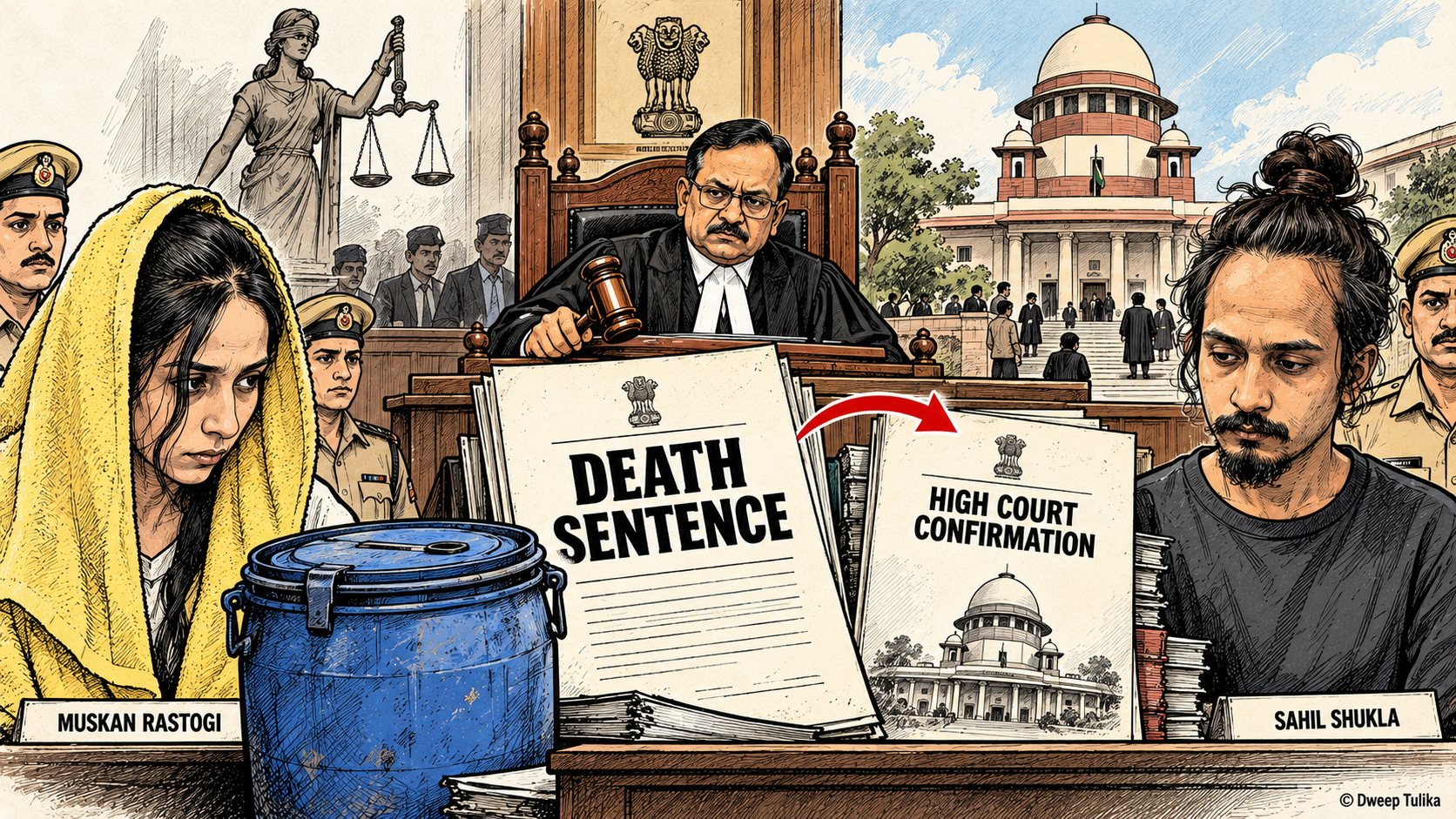
A Meerut court has sentenced Muskan Rastogi and Sahil Shukla to death for the murder of Saurabh Rajput, a former Merchant Navy officer whose dismembered remains were concealed inside a cement-filled blue plastic drum. The sentence, pronounced on October 14, follows a 13-month trial that culminated in the conviction of the two accused on September 30.
The case, which came to national attention in March 2025, involved the killing of Rajput at his home, the concealment of his remains and attempts to mislead his family about his whereabouts. The sentencing brings the trial court proceedings to a major milestone, although the death penalty remains subject to mandatory High Court confirmation.
District and Sessions Judge Arvind Kumar Mishra pronounced the sentence after 126 hearings and the examination of 22 prosecution witnesses. The court also imposed fines of ₹50,000 each for murder and ₹20,000 each for causing the disappearance of evidence, according to reports citing the prosecution.
What happened to Saurabh Rajput?
Rajput, 35, returned to Meerut from London in late February 2025. According to the prosecution's account, he was killed at his home on the night of March 3–4, 2025.
Investigators alleged that Muskan, his wife, and Sahil, who was reportedly in a relationship with her, conspired to murder him. The prosecution said Rajput was drugged and stabbed before his body was dismembered.
His remains were placed inside a blue plastic drum and concealed using a mixture containing cement and sand.
The case came to light around two weeks later, when Rajput's family became suspicious about his unexplained absence. Police recovered the remains from the drum at the couple's residence in Meerut and arrested the two accused in March 2025.
Investigators subsequently assembled a case based on forensic material, call-detail records, CCTV footage and witness statements. Police filed a chargesheet running to nearly 1,000 pages in May 2025, according to contemporary reporting.
The evidence presented during the trial
The prosecution relied on circumstantial evidence to establish the sequence of events and the alleged conspiracy. Reports on the trial refer to forensic evidence, witness testimony and records of the movements of the accused after the murder.
There was no eyewitness to the killing, according to reporting on the case. The prosecution therefore relied on the combined weight of the evidence gathered during the investigation.
The court convicted Muskan and Sahil on September 30, 2026, of murder and destroying or causing the disappearance of evidence. The sentencing hearing followed on October 14, when the prosecution sought the death penalty.
The court subsequently imposed capital punishment on both convicts.
Court invokes the Mahabharata while pronouncing sentence
The sentencing attracted further attention after prosecution counsel K. K. Chaubey told reporters that the judge had referred to the Mahabharata while discussing the duty to punish offenders.
According to the counsel's account, the court observed that punishing those found guilty in proportion to the gravity of their crime was also a matter of dharma.
The court reportedly described the murder as exceptionally grave and emphasised the need for punishment commensurate with the crime. The detailed written judgment is the authoritative source for the court's complete reasoning, including its assessment of aggravating and mitigating circumstances.
Why the death sentence is not yet final
Although the trial court has imposed the death penalty, the sentence cannot be carried out merely on the strength of the sessions court's order.
Under Indian criminal procedure, a death sentence passed by a sessions court must be submitted to the High Court for confirmation. The High Court independently examines the case and may confirm the sentence, impose another lawful sentence, annul the conviction or order further proceedings as permitted by law.
Reports published on October 15 indicate that Muskan and Sahil intend to challenge the death sentence before the Allahabad High Court. The next major development will therefore be the confirmation proceedings and any appeal filed by the convicts.
The distinction matters: the trial court has convicted and sentenced them, but the appellate process remains an essential safeguard in a case involving capital punishment.
The family awaits the next stage of justice
Rajput's family had sought the maximum punishment following the convictions. His mother, Renu Rajput, had publicly questioned why her son was killed and expressed her desire for the harshest sentence.
The sentencing has brought a measure of closure for the family, but the legal process is not complete. The High Court's examination will determine whether the death sentences are confirmed or altered.
The case has also drawn attention to the wider consequences of violent crime for surviving children and family members. Reporting after the sentencing said Muskan's infant daughter, Radha, remained with her mother in Meerut district jail, while arrangements concerning the child's future continued to be discussed.
Those circumstances are separate from the question of criminal liability and sentencing, but they underline the long-term impact of the case on the families involved.
What happens next?
The immediate legal focus will be on the High Court's mandatory confirmation of the death sentences and the appeals expected from the convicts.
The proceedings will require the appellate court to examine the evidence, the trial court's reasoning and the legal standards governing capital punishment. Until that process is completed, the sentences should be described as death sentences imposed by the trial court, not as executions that are certain to take place.
For now, the Meerut verdict marks a significant stage in a murder case that shocked the country because of the concealment of the victim's remains and the evidence presented during the trial. The next chapter will be decided through the appellate process.
Sources: The Indian Express, September 30 and October 14, 2026; The Times of India, October 14, 2026; NDTV, October 14, 2026; The New Indian Express, October 15, 2026.