
NEW DELHI | OCTOBER 22, 2026
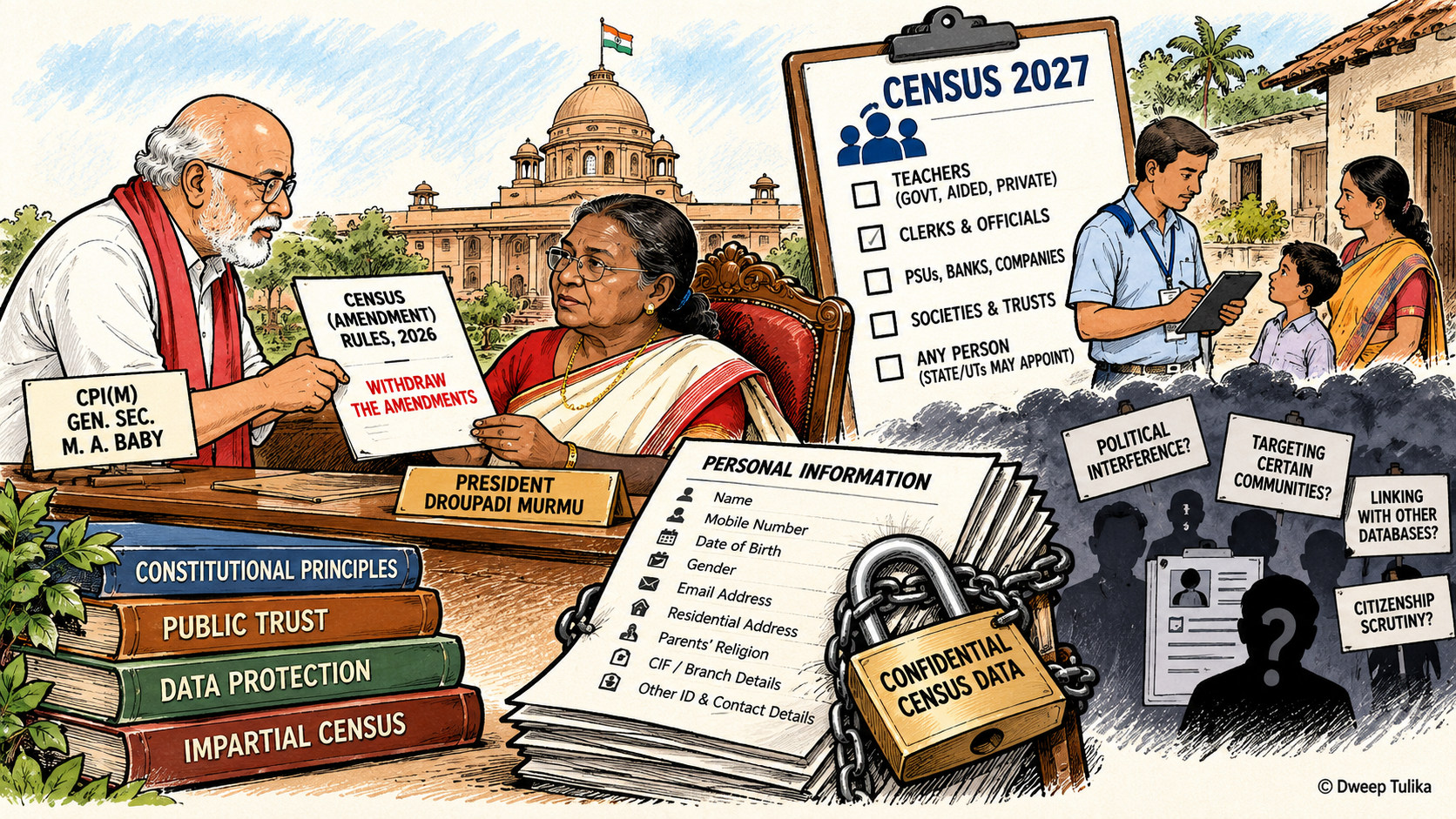
The Communist Party of India (Marxist) has urged President Droupadi Murmu to intervene and seek the withdrawal of amendments to the Census Rules, 1990, arguing that the changes raise concerns about the impartiality of enumerators, the confidentiality of personal information and safeguards against political interference.
In a letter to the President, CPI(M) General Secretary M. A. Baby expressed concern over the Census (Amendment) Rules, 2026, notified by the Union Ministry of Home Affairs on October 16. The party has called for the census exercise to be conducted in a manner that protects public trust and complies with constitutional principles.
The letter argues that the expanded eligibility criteria for census enumerators could create scope for arbitrary appointments and undermine public confidence in the collection of sensitive personal information.
What Do the Amended Census Rules Change?
The amendments expand the categories of people eligible to be appointed as census enumerators.
Under the revised rules, eligible personnel include teachers from government, local-authority, aided and unaided private educational institutions, as well as teachers associated with societies and trusts. Clerks and other officials working in central and state government departments, local authorities, public sector undertakings, statutory bodies, banks, companies and other institutions may also be appointed.
The amended rules additionally allow state governments and Union Territory administrations to appoint any person they consider suitable to perform enumerator duties.
The changes were notified through the Census (Amendment) Rules, 2026, under the Census Act, 1948. The amendments came into force upon publication in the Official Gazette on October 16.
CPI(M) has questioned whether the broader eligibility criteria are accompanied by sufficiently clear selection standards and safeguards against partisan interference. The party argues that the discretion granted to state and Union Territory administrations could permit arbitrary or politically motivated appointments.
The amended rules establish the expanded eligibility categories; the party's concerns about their potential misuse are its assessment of the changes.
CPI(M) Raises Concerns Over Personal Data
The letter highlights the sensitive nature of information collected during a census, which involves households and individuals across the country.
Baby argues that people may be reluctant to disclose personal details if they do not trust the individuals collecting the information. The party has warned that fears of political profiling, targeting of particular communities, citizenship-related scrutiny or the denial of legitimate rights could undermine public confidence in the exercise.
The letter also refers to the questionnaire notified for the second phase of Census 2027 on August 14, 2026. According to the party, the questionnaire seeks a wide range of personal details, including information concerning parents' religion and various identification and contact details.
These statements reflect the concerns set out in the party's letter. The letter does not establish that census information has been misused or that the amended rules themselves permit such misuse.
The central demand is for safeguards that protect confidentiality and ensure information collected for census purposes is not diverted to unrelated uses.
Earlier Memorandum on Census Data
CPI(M) said it had submitted a memorandum to the Registrar General and Census Commissioner of India on August 24, calling for the collection of certain personal details to be stopped and for stronger safeguards over census data.
The earlier memorandum also sought assurances that census information would not be linked with other databases or used for purposes beyond those for which it was collected.
According to the party, the latest amendments have made these concerns more urgent by expanding the pool of people who may be appointed to collect census information.
The letter argues that clear rules governing appointments, accountability and data protection are essential to maintaining public confidence in a nationwide exercise.
CPI(M) Draws a Comparison With the SIR Exercise
The party has also referred to the ongoing Special Intensive Revision (SIR) of electoral rolls, alleging that eligible citizens have faced exclusion through opaque procedures and arbitrary documentation requirements.
In the letter, CPI(M) argues that these concerns make it particularly important to establish strong safeguards before sensitive information is collected on a nationwide scale by an expanded network of enumerators.
The comparison is part of the party's political and policy argument. The letter does not establish that the census amendments and the SIR process are legally or operationally equivalent.
CPI(M) maintains that census information must not be used as a tool for political surveillance, citizenship determination or electoral exclusion.
Appeal to the President
In its appeal, CPI(M) has asked President Murmu to intervene and call upon the Union Government to withdraw the amendments.
The party argues that the census is a national exercise that must serve the public interest rather than the political interests of the party in power or its ideological affiliates. It has called for the process to be conducted in a manner consistent with constitutional principles, confidentiality and public trust.
The letter does not itself change the rules, and no withdrawal is established by the document. The requested intervention remains a demand made by the party.
The Wider Issue: Trust and Census Data Protection
The controversy centres on two questions: who should be eligible to collect census information, and what safeguards should govern the handling of the information gathered.
The amended rules broaden the categories of eligible enumerators, including personnel from private institutions and other organisations, while allowing state and Union Territory administrations to appoint additional suitable persons. CPI(M) argues that transparent selection criteria and effective protections are necessary to prevent political interference and protect privacy.
The practical implications will depend on how appointments are made, what safeguards govern enumerators' conduct and how census data are protected from unauthorised access or use.
For now, the party is seeking withdrawal of the amendments and stronger assurances over the confidentiality and use of personal information. The issue places the administration of Census 2027, public trust and data protection at the centre of an ongoing policy debate.
Source: Letter from CPI(M) General Secretary M. A. Baby to the President of India, supplied to Dweep Tulika; reporting by The New Indian Express and The Tribune.