
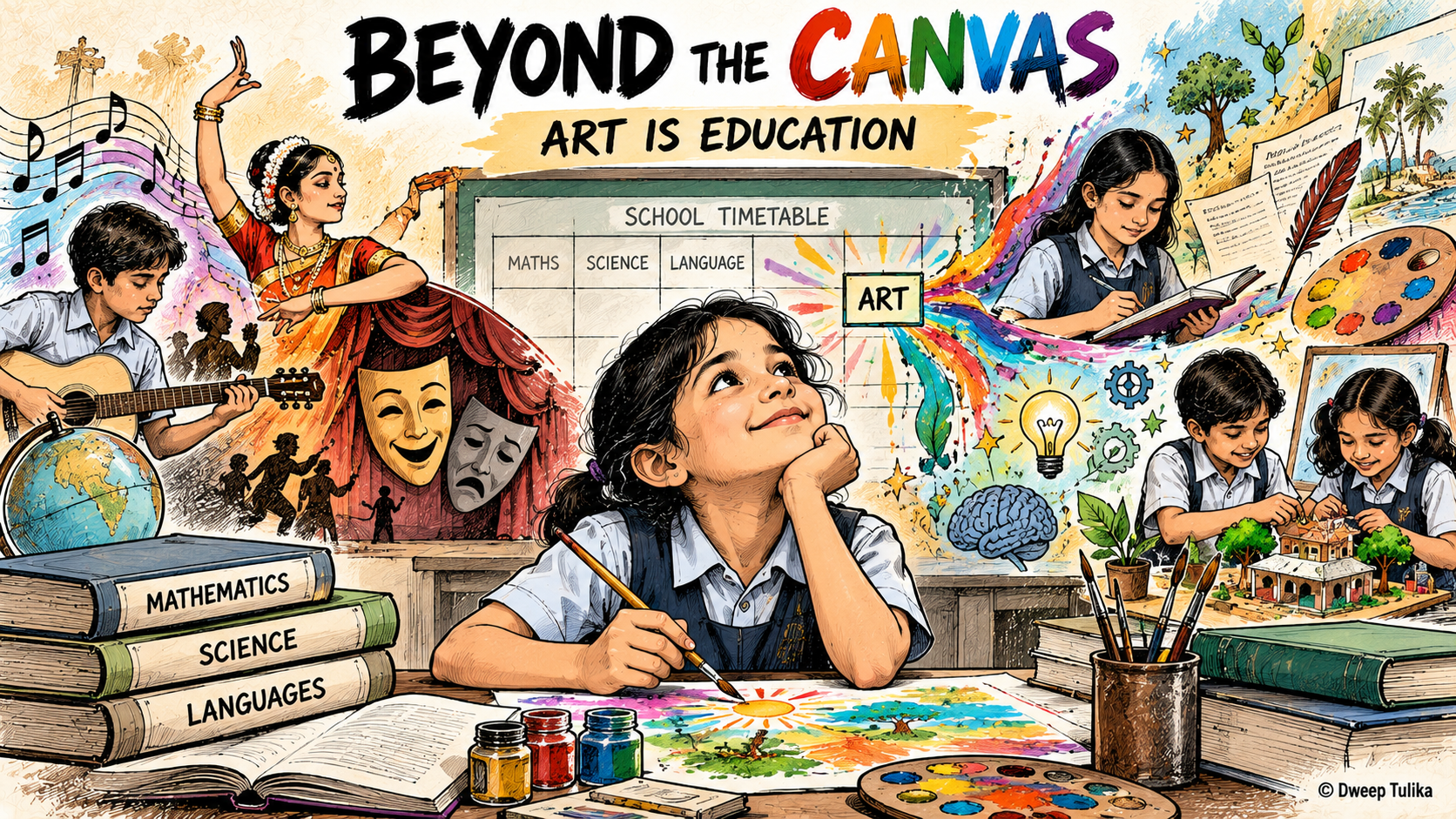
Beyond the Canvas: Why Art Education is the Core of a Child’s Intellectual Awakening
In the architecture of modern school education, art is often relegated to the margins. Tucked away neatly in the timetable under the label of "co-curricular" or "extracurricular," it is frequently treated as a pleasant distraction, a whimsical break from the "real" academic rigor of mathematics, science, and languages. This label does more than just minimize art; it fundamentally misunderstands what art education actually achieves. Art is not merely a hobby, nor is it just about learning how to paint a sunset or tune an instrument. When a child engages in music, visual arts, theatre, dance, creative writing, or any other art form, they aren't just taking a break from cognition, they are exercising entirely different, highly complex neural pathways. True education should bridge logic and imagination; separating them creates an artificial divide that robs children of holistic growth.
The Cultural Paradigm: Bharat’s Timeless Heritage
To understand how skewed our current perception has become, one must look at the civilizational roots of Bharat. Historically, art was never viewed as a secondary pursuit or a mere hobby. From the foundational wisdom of the Vedas and Upanishads to treatise systems like the Natya Shastra and the Gandharva Veda, the Kalās (arts) were recognized as essential dimensions of human consciousness and intellect. In ancient Indian thought, science, philosophy, and art were deeply interconnected disciplines rather than isolated subjects. By reducing art to a "co-curricular" footnote today, modern education creates a tragic disconnect from our own rich heritage, treating a foundational pillar of human wisdom as a superficial afterthought.
The Societal Mindset and the Collective Void
This systematic neglect does not merely rob the individual child; it creates a damaging, long-term gap in the collective mindset of society. When a system repeatedly signals that creative pursuits are inferior to utilitarian subjects, it conditions society to measure human worth through a rigid, transactional lens. A culture that trivializes art slowly loses its capacity for nuanced thinking, aesthetic appreciation, and original innovation. It produces a workforce capable of executing tasks, but starves the nation of visionary thinkers, empathetic leaders, and creative problem-solvers. The societal gap manifests as a loss of cultural literacy, where generations grow up detached from the depth of their artistic traditions and incapable of creative self-expression.
Cultivating the Intellectual Mind
Art shapes the intellectual individual in profound ways. First, it fosters critical thinking and a comfort with ambiguity. In mathematics or standard testing, there is usually a right or wrong answer, but art introduces children to the realm of ambiguity by teaching them that a single prompt can have a hundred different, valid interpretations. This builds cognitive flexibility, teaching students how to approach complex, real-world problems where clear-cut answers do not exist.
Second, mastering any art form, whether practicing classical vocal notes, learning rhythm, or drafting a script—demands immense discipline, patience, and self-reflection. Simultaneously, art forces children to step into someone else’s shoes, whether through a theatrical role or a lyrical composition, naturally building profound empathy and emotional awareness. Third, music and visual arts require intense sensory integration. Reading notes, maintaining rhythm, or visualizing spatial proportions stimulates memory retention, fine motor skills, and sustained concentration, which invariably spills over into academic excellence.
Nurturing the Whole Child
When schools treat art as central rather than optional, they give children permission to find their authentic voice. An intellectually robust individual is not just someone who can memorize facts, but someone who can create, innovate, and look beyond the obvious. Art gives children the courage to make mistakes, experiment, and discover meaning. It is time we stop viewing art as a mere "filler" in the school day, reclaim our civilizational understanding, and recognize art for what it truly is: an indispensable pillar of human intellect, societal harmony, and living expression.